
NFL Bankroll Management and Staking Systems
 Available in US
My first NFL season as a serious bettor ended with a 54% win rate on point spreads and a net loss of £320. I had done the analysis right, picked more winners than losers, and still finished in the red — because I had no staking plan. When I felt confident, I bet three times my usual amount. When I was chasing a losing Sunday afternoon, I doubled up on the evening game. Fifty-four percent winners, negative balance. That paradox is the single best argument for bankroll management: skill without structure is just entertainment with extra maths. Among regular NFL bettors, 63% wager on at least one game every week through the season, and without a staking plan, that consistent activity can quietly erode a bankroll even when the selections are sound.
Implementing the Unit System for NFL Bets
Before the 2023 season I sat down with a blank spreadsheet and made one decision that transformed my results: I defined a unit. One unit equalled 1% of my dedicated NFL bankroll. Not 1% of my savings account, not 1% of what I could afford to lose that month — 1% of a specific sum set aside exclusively for NFL betting. That separation is the entire foundation.
A unit is an abstraction, and that is its power. When you think in units instead of pounds, you detach the emotional weight from the number. Betting 2 units on a game you have strong conviction on feels measured and rational. Betting £50 on the same game can feel either reckless or insignificant depending on your relationship with £50 at that moment. Units normalise your stakes against your total bankroll, which means your bet sizing stays proportionate regardless of whether your bankroll is £500 or £5,000.
The standard recommendation among experienced bettors is to wager between 1 and 3 units per bet, with 1 unit as the default and 2-3 units reserved for plays where your edge is largest. I go a step further and cap myself at 2 units, because the temptation to escalate to 3 tends to correlate with overconfidence rather than genuine analytical edge. Over a full NFL season of 272 regular-season games plus playoffs, you will place enough bets that the law of large numbers works in your favour — provided your average stake is small enough to survive the inevitable losing streaks.
How large should the bankroll itself be? Enough to absorb a bad month without going bust. The NFL season typically demands a bankroll that can withstand 20-30 consecutive unit losses — an extreme scenario, but one that stress-tests your plan against the worst case rather than the average case. If your unit is £10, you need a minimum bankroll of £300. If you want a cushion that lets you bet comfortably, £500 is more realistic. The NFL generates more wagering volume than any American league despite fewer than 300 regular-season games, which means each game carries outsized significance for your bankroll — one bad Sunday can represent a full week’s action.
Flat Staking vs Percentage Staking: Which Works for NFL
During the 2024 season I ran a side-by-side experiment: flat staking on my primary account, percentage staking on a secondary. Same selections, same conviction levels, different bet-sizing methods. The results taught me more about risk management than any textbook.
Flat staking means betting the same amount — say, 1 unit — on every wager. Your bankroll rises and falls in a straight line relative to wins and losses. The method is simple, eliminates decision fatigue around bet sizing, and ensures you never accidentally over-expose your bankroll to a single game. Its weakness is that it does not adapt: when your bankroll grows, your stakes remain the same, so your potential returns do not compound. When your bankroll shrinks, your stakes remain the same, so losing streaks consume a larger percentage of what remains.
Percentage staking — also called proportional staking — adjusts your unit size as your bankroll changes. If your rule is 2% per bet, and your bankroll is £1,000, your stake is £20. If the bankroll drops to £800, your stake drops to £16. If it grows to £1,200, your stake rises to £24. This approach naturally decelerates losses during bad runs and accelerates gains during good ones. The drawback is complexity: you need to recalculate your unit after every bet, and during a 14-game NFL Sunday you might place six or seven bets in rapid succession.
My experiment showed that percentage staking produced a higher end-of-season balance when I had a winning record, but flat staking lost less during the four-week losing streak I hit in November. For most UK bettors — especially those who wager on three to five games per week — flat staking is the better starting point. It is easier to execute, easier to track, and removes the temptation to manipulate the system by selectively recalculating your bankroll at convenient moments.
Budgeting Across an NFL Season From September to February
The NFL calendar is not uniform, and your bankroll strategy should reflect its rhythms. September games are high-variance — small sample sizes, roster turnover, coaching changes, and uncertain team identities make early-season betting inherently riskier. By November, the data stabilises, edges become clearer, and your confidence in your ratings should increase. The playoffs compress everything: fewer games, higher stakes, more public money distorting the odds.
I divide my season into three phases. Phase one, Weeks 1-5, is the research period. I bet at minimum stakes — strictly 1 unit — and treat every game as a calibration exercise, comparing my projected lines against the market to see where my model is off. Phase two, Weeks 6-18, is the core betting window. This is when I deploy 1-2 unit plays based on a model that has been refined by five weeks of real data. Phase three, the playoffs, is selective. I reduce frequency — betting on perhaps two or three games per round instead of every matchup — and maintain 1-unit stakes despite the temptation to increase sizing for higher-profile games.
The budget itself needs a monthly ceiling, separate from your per-bet unit system. If your season bankroll is £1,000, divide it across the six months of the NFL calendar. That gives you roughly £165 per month as a replenishment cap — the maximum you add to your betting accounts in any given month. If you run hot in October and your bankroll grows to £1,300, you skip the November top-up. If you run cold and your bankroll drops to £700, you add £165 but accept that your unit size has effectively decreased. This structure prevents the most common mistake in NFL season betting: loading fresh funds after a bad week to maintain the same unit size, which is just chasing losses with extra steps.
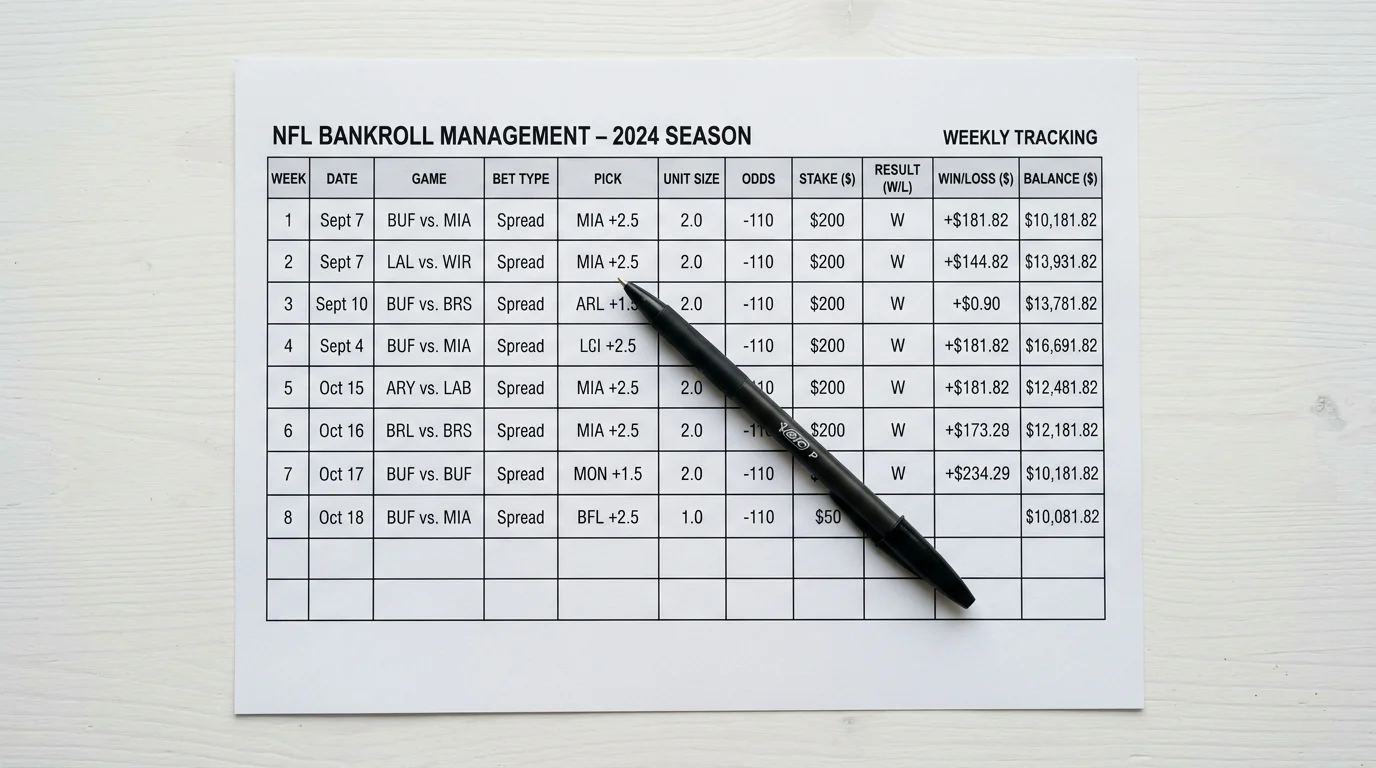
Track everything in a spreadsheet or dedicated app. Record the date, game, bet type, odds, stake in units, result, and profit or loss. Review weekly. The responsible gambling guide covers the self-protection tools available on UK platforms, including deposit limits that enforce your monthly budget automatically.
What percentage of bankroll should I stake on a single NFL bet?
Most experienced bettors recommend 1-3% of your dedicated NFL bankroll per bet, with 1% as the standard unit and higher percentages reserved for plays with the strongest analytical edge. Starting at 1% gives your bankroll enough resilience to absorb losing streaks across a full season.
How do I adjust my bankroll for the NFL playoffs?
Reduce bet frequency rather than increasing stake size. The playoffs offer fewer games but attract heavy public betting that can distort odds. Maintain your regular unit size, be more selective about which games you bet, and resist the temptation to size up because the games feel more important.
Prepared by the Sports Betting nfl editorial staff.