NFL Betting UK vs US: Market and Odds Differences
 Available in US
I placed my first NFL bet in a Las Vegas sportsbook in 2017 — a Monday Night Football spread written in American odds that I had to mentally convert before I even knew if the price was decent. Two days later I was back home in the UK, loading the same fixture on a British bookmaker with decimal odds, a cash-out button, and an accumulator builder I would never see stateside. That single week taught me more about the transatlantic divide than any guide ever could.
The UK ranks third globally in gambling revenue at roughly $27 billion a year, and the American market has exploded since individual states began legalising sports betting. Yet the experience of wagering on an NFL game in London and doing the same in New Jersey could hardly feel more different. Odds formats, bonus structures, regulatory frameworks, and even the vocabulary change the moment you cross the Atlantic. US sportsbook revenue hit $1.92 billion in November 2025 alone — a 16.5 per cent year-on-year jump — and that growth is reshaping how British bookmakers package their own NFL product.
This article breaks down the practical differences that matter when you sit down to bet on American football from a UK account. Some are obvious, others are surprisingly subtle, and a few could genuinely cost you money if you do not account for them.
NFL Market Availability Across UK and US Platforms
The first time I opened a US sportsbook app during a trip to Pennsylvania, the NFL tab looked almost barren compared to what I was used to at home. Three main markets — spread, moneyline, total — sat front and centre with minimal navigation. In contrast, a typical UK bookmaker lists thirty or more markets for a single NFL fixture: first touchdown scorer, team totals, half-time result, player yardage props, and various handicap options, all visible without scrolling far. That breadth is not accidental; British operators have decades of experience with football and horse racing prop markets, and they simply port the same depth to American football.
American sportsbooks have been catching up fast, especially the big operators that launched post-legalisation, but the default experience still leans heavily on the big three bet types. Sixty-one per cent of US NFL bettors gravitate toward the point spread, with moneyline and over/under trailing behind at 52 and 47 per cent respectively. UK punters interact with those same markets, of course, but the presentation is different. Spreads appear as “handicap” lines, moneylines become “match winner,” and totals carry the same logic under a familiar decimal-odds shell.
One area where American books genuinely lead is same-game parlay builders. DraftKings and FanDuel invested heavily in correlation engines, and their SGP products launched well before most UK operators offered anything comparable for NFL. British bookmakers now provide bet builders for NFL — and some are excellent — but the American versions tend to accept more exotic combinations, partly because US operators built them for a market that already understood parlay culture. Where UK bettors shine is in pre-match depth: early lines, ante-post season markets, and specials that American books rarely bother with until closer to kick-off.
Odds formatting remains the most visible gap. A UK punter sees 2.10 or 11/10; an American sees +110. All three represent the same implied probability, yet the psychological framing changes how people assess value. If you are comparing prices across the Atlantic — and serious bettors absolutely should — learning to read American odds is not optional, it is a basic survival skill. I covered that process in detail in my guide to NFL odds for UK bettors.
UKGC vs US State-by-State Regulation: Consumer Protections
A colleague from Chicago once asked me how I could trust a bookmaker that was not backed by a state gaming commission. I laughed, because from a British perspective the question runs the other way round. The UK Gambling Commission has regulated online betting nationally since 2005. One licence, one rulebook, one complaints process for every operator serving UK customers. In the United States, legalisation rolls out state by state, and each jurisdiction writes its own rules, sets its own tax rates, and decides which operators can enter. A bettor in New York faces different protections than one in Arizona, and an operator licensed in New Jersey cannot automatically serve someone in Ohio.
That patchwork creates friction. US bettors who travel across state lines sometimes find their accounts locked because geolocation fencing detects they have left their licensed state. A UK punter can place a bet from any postcode in the country — and from abroad, too, depending on the operator’s terms. The UKGC’s single-market structure also means that consumer complaints, self-exclusion schemes, and responsible-gambling tools work uniformly. Since April 2025, online slot stake limits of five pounds per spin for over-25s and two pounds for 18-to-24-year-olds have added another layer of protection. A statutory levy of 0.1 to 1.1 per cent of gross gambling yield now funds research, education, and treatment — a mandatory contribution that no US state has replicated in quite the same way.
Where American regulation arguably does better is in transparency around odds compilation. Several US states require sportsbooks to report hold percentages and handle data, which gives bettors and analysts a clearer view of the market. The UKGC collects similar data but publishes it in aggregate, making it harder to compare individual operators. For NFL specifically, the US regulatory environment also means that official league data partnerships are baked into licensing agreements, so live betting feeds tend to be marginally faster in American apps. The practical difference is small, but for in-play bettors chasing closing-line value on a Thursday Night Football game, every fraction of a second counts.
Accumulators, Free Bets, and Other Cultural Quirks
Walk into any UK pub on a Sunday evening during NFL season and you will hear someone say “I’ve got a four-fold on the late games.” In America, the same bet is a “four-leg parlay,” and nobody calls it anything else. The vocabulary divide runs deeper than you might expect. Accumulators, each-way bets, yankees, lucky fifteens — these are concepts woven into British betting culture from decades of horse racing, and they carry over seamlessly into NFL wagering. American bettors rarely encounter an each-way option, and multi-bet structures beyond the parlay are almost nonexistent on US platforms.
Free bets tell a similar story. UK operators compete aggressively on sign-up offers: bet-ten-get-thirty deals, acca boosts, enhanced odds on the first touchdown scorer. The promotional landscape is regulated but generous, and NFL games — especially Monday Night Football and the London fixtures — attract dedicated bonus campaigns. In the US, sign-up bonuses tend to be larger in nominal terms (thousand-dollar deposit matches are common) but carry rollover requirements that British punters would find bewildering. A US new-customer offer might demand you wager the bonus amount five or ten times before withdrawal, whereas a UK free bet typically returns only the profit with no further strings.
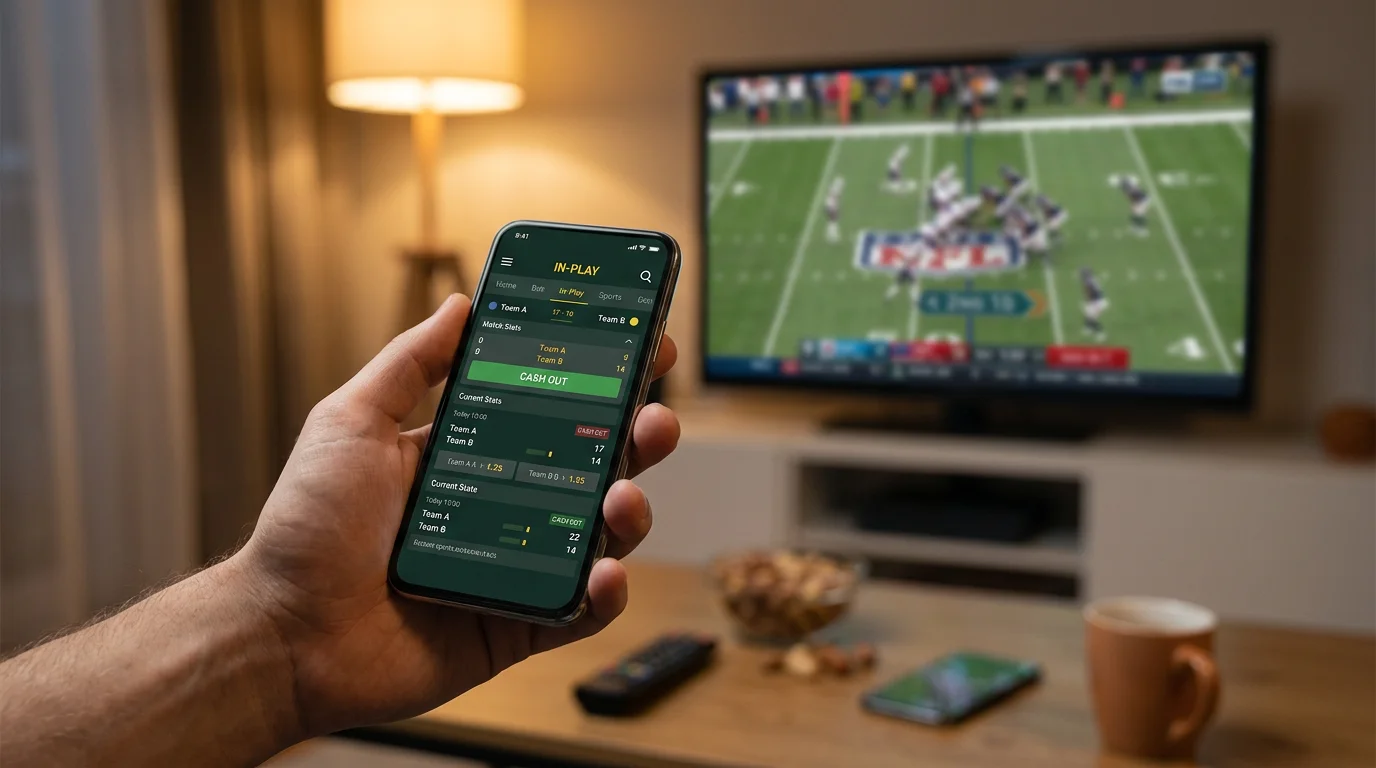
Cash out is another cultural marker. British bookmakers pioneered early settlement, and UK punters expect full or partial cash-out options on virtually every NFL market. American sportsbooks offer cash out too, but the feature arrived later and still feels less polished on some platforms. I find myself reaching for the cash-out button on a Sunday afternoon far more often on my UK accounts than I ever did on American ones — partly because the interface encourages it and partly because the margins on the feature tend to be slightly tighter in a competitive UK market.
Even the rhythm of betting differs. Americans tend to bet close to kick-off, driven by a culture of last-minute line shopping. British punters — trained by horse racing — place early bets to lock in value and then top up in-play. Neither approach is inherently better, but understanding which camp your bookmaker caters to helps you time your bets more effectively.
Frequently Asked Questions
Can UK punters use American sportsbook promotions?
No. US sportsbooks are geofenced by state law, so you need to be physically located in a licensed US state to create an account or place a bet. Even if you travel to the US and sign up, you cannot access the account once you return to the UK. British punters should stick to UKGC-licensed operators, which offer their own NFL-specific promotions and free-bet deals throughout the season.
Are NFL odds better in the UK or the US?
It depends on the market. US sportsbooks often have tighter margins on headline NFL spreads and totals because competition among dozens of state-licensed operators drives prices down. UK bookmakers tend to offer more competitive odds on prop bets, futures, and touchdown scorer markets where their pricing models have longer track records. Serious NFL bettors compare both where possible and use odds-comparison tools to find the best price for each individual wager.
Published by the Sports Betting nfl team.