NFL Line Movement Tracker: Analyzing Odds Shifts
 Available in US
I once watched a line move from Bills -3 to Bills -1 over the course of 48 hours without a single injury being reported. No weather change, no roster news, nothing in the public domain that explained a two-point shift on a marquee game. Then, on Friday afternoon, a report surfaced that the Bills’ starting left tackle had aggravated a knee issue in practice and was doubtful. The line had already moved. The money knew before the news broke. That is the essence of line movement in NFL betting — the odds are a living reflection of information, and sometimes the information arrives through wagers before it arrives through press conferences. The NFL commands roughly $30 billion in legal wagers per season, and every dollar of that volume shapes the odds that appear on your UK bookmaker’s screen.
Key Factors Driving NFL Betting Line Movements
An NFL line moves for one of three reasons: balanced liability, new information, or sharp action. Understanding which force is behind a movement tells you whether to react, ignore it, or bet against it.
Balanced liability is the most common driver. When a bookmaker opens a line and receives heavy one-sided betting, they adjust the odds to attract money on the other side. If the public pounds the Chiefs at -7.5, the bookmaker might move the line to -8 to make the opposing team more attractive. This type of movement reflects public sentiment, not analytical insight. The bookmaker is managing their risk, not expressing an opinion. For UK bettors, this means that public-driven line movement — particularly on popular teams and primetime games — often creates value on the side the public is avoiding.
New information moves lines in the most intuitive way. An injury to a key player, a weather forecast change, or a late roster decision directly alters the expected outcome of the game, and bookmakers adjust accordingly. A starting quarterback listed as questionable might cause a 1-2 point movement; confirmation that he is out might trigger another 1-2 points. The speed of these adjustments varies by bookmaker. American sportsbooks tend to react faster than UK platforms because they are closer to the source of the news and face sharper bettors hitting their lines immediately. This time lag — sometimes measured in minutes, sometimes in hours — creates a window for UK bettors who monitor American injury feeds in real time.
Sharp action is the most interesting and least understood driver. Professional bettors — often syndicates with large bankrolls and sophisticated models — place wagers that bookmakers respect as informed opinion. When a sharp bettor stakes a significant sum on one side of a game, the bookmaker moves the line not just to balance their book but because they trust that the sharp’s analysis is likely correct. William Hill holds 37.83% of PPC traffic in the UK sports betting segment, and the lines across major UK platforms often move in response to sharp activity at wholesale American sportsbooks, filtered through a chain of market-making that connects Las Vegas to London within hours.
How to Track and Read NFL Line Movements From the UK
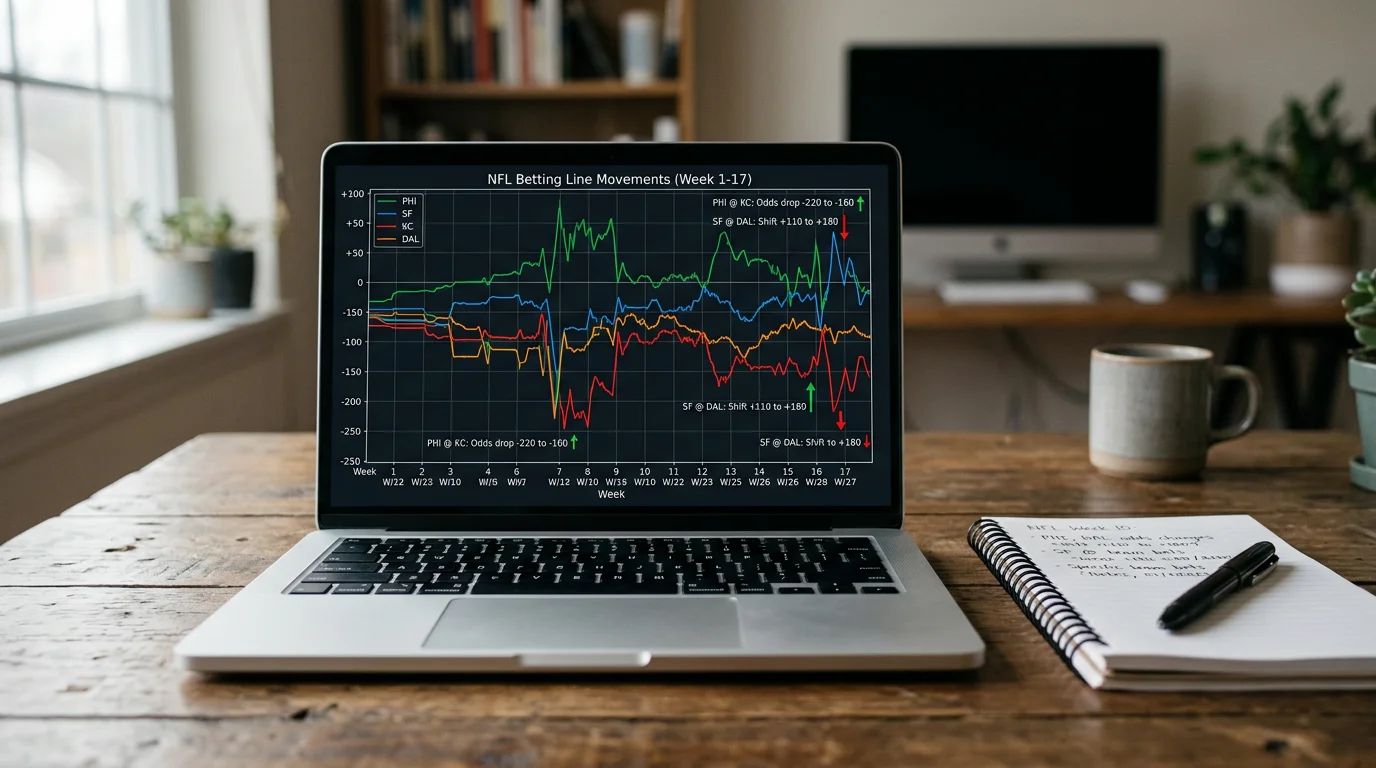
Tracking line movement requires two things: the opening line and a way to see how it has changed. Most UK bookmakers do not display line history — they show you the current price and nothing else. This means you need external tools or your own records to capture the opening number and monitor shifts.
Several free American-based websites publish NFL opening lines, typically posted on Tuesday or Wednesday, and track every subsequent movement. These sites update in near real time and colour-code movements to show direction and magnitude. Bookmarking one of these trackers and checking it twice daily — morning and evening UK time — gives you a clear picture of how each game’s line is developing through the week.
The key metric to watch is not the size of the movement but its direction relative to the betting percentages. Most tracking sites also display the percentage of bets (number of tickets) and the percentage of money (total wagered) on each side. When 70% of bets are on Team A but the line moves towards Team B, that is reverse line movement — the bookmaker is adjusting against the public majority, typically because the 30% backing Team B includes sharper, higher-volume bettors whose money outweighs the public’s ticket count.
I record every opening line for my weekly slate on Tuesday and compare it against the closing line on Sunday. Over a full season, this log reveals patterns: which teams the market consistently adjusts towards, which types of games attract sharp disagreement with the public, and how quickly UK bookmakers react compared to their American counterparts. This historical record is more valuable than any single week’s line movement, because it trains your eye to distinguish meaningful shifts from routine balancing.
When to Act on NFL Line Movement and When to Wait
Not every line movement demands a response. The temptation to chase a moving line — grabbing the current number before it shifts further — is one of the fastest ways to erode your edge, because you end up taking positions based on other people’s opinions rather than your own analysis.
I act on line movement in exactly two scenarios. First, when my pre-existing analysis aligns with the direction of a sharp-driven move. If I projected a game at -3 and the line moves from -1 to -2.5 on sharp action, the market is converging towards my number. I bet, because my analysis and the sharp money agree, and I want to capture the remaining value before the line reaches -3. This is not following the sharps blindly — it is using their action as confirmation of independent work.
Second, when a large public-driven move creates value on the opposite side. If the public pushes a line from -7 to -8.5 on a popular team without any new information, the extra 1.5 points of value on the underdog might be worth a bet even if the underdog was not on my radar before. The public has artificially inflated the favourite’s line, and the correction — which often comes as a late sharp move back towards the opener — can be anticipated.
When to wait: always when you are uncertain whether the movement is information-driven or money-driven. If a line moves sharply on a Wednesday and you cannot identify the cause, patience is the correct response. By Friday, the reason usually becomes clear — an injury report, a practice status, a weather update — and you can make an informed decision rather than a reactive one. The value bets guide covers how to assess whether a line movement has created genuine value or merely shifted the odds to a different equilibrium.
How quickly do NFL lines move on UK bookmaker sites?
UK bookmaker lines typically adjust within hours of significant American market movements, though they can lag by 30 minutes to several hours on breaking news. Lines move fastest around major injury announcements and on Friday or Saturday when final practice reports are released. Monitoring American line trackers gives UK bettors a real-time view.
Does reverse line movement indicate sharp betting on the NFL?
Reverse line movement — where the line moves against the majority of public bets — is one of the strongest indicators of sharp money in NFL markets. It suggests that the smaller percentage of bettors on one side are wagering significantly larger amounts, and the bookmaker trusts their informed opinion enough to adjust the line.
Created by the ”Sports Betting nfl” editorial team.