NFL Value Bets UK: Identifying Mispriced Odds
 Available in US

I placed a bet on the Jacksonville Jaguars at 7/2 to beat the Chargers in Week 14 of the 2022 season. Jacksonville had won three straight, their defence was peaking, and the Chargers were dealing with a banged-up offensive line. The bookmaker’s price implied Jacksonville had roughly a 22% chance of winning. My own numbers — based on recent form, defensive matchups, and injury-adjusted efficiency — put them closer to 35%. That gap between the bookmaker’s implied probability and my estimated probability was the entire reason the bet existed. Jacksonville won 38-10. The scoreline was a bonus. The value was the point.
Finding value is not the same as picking winners. You can back a team that loses and still have made a good bet, provided the odds were wrong in your favour. The NFL attracts roughly $30 billion in legal wagers per season in the United States alone, and with 13 million fans in the UK following the sport, the British market is deep enough that bookmakers cannot perfectly price every game. Mispriced odds exist every week. The challenge is building a process to identify them consistently rather than relying on gut feeling.
Core Principles of Identifying NFL Value Bets
I spent my first two years of NFL betting thinking value meant “big odds on an underdog.” It does not. A 1/5 favourite can be a value bet if your analysis says they should be priced at 1/8. Value is a mathematical relationship, not a price tag.
The concept works like this. Every set of odds implies a probability. Decimal odds of 3.00 imply a 33.3% chance of winning. If you believe the true probability is 40%, the bet has value — you are getting paid at a rate that assumes the outcome is less likely than it actually is. Over hundreds of bets, consistently finding these discrepancies produces profit even when individual bets lose, because the odds are systematically in your favour.
To calculate whether a bet has value, convert the bookmaker’s odds into an implied probability, then compare that number against your own assessed probability. The formula for decimal odds is straightforward: divide 1 by the decimal odds, multiply by 100. At odds of 2.50, the implied probability is 40%. If your model or analysis assigns a 48% probability to that outcome, you have eight percentage points of edge. That is substantial.
The hard part is not the maths — it is building the analytical framework that produces accurate probability estimates. You need a system for rating teams that accounts for offensive and defensive efficiency, strength of schedule, injuries, rest advantages, and situational factors like weather and travel. Some bettors build statistical models in spreadsheets. Others rely on deep qualitative analysis of film and matchups. The method matters less than the discipline of assigning your own probability before you look at the bookmaker’s price. If you check the odds first, your estimate gets anchored to their number, and the entire exercise collapses.
One mistake I see constantly: confusing public perception with probability. When a team like the Chiefs is heavily backed by casual bettors, their odds shorten — not because they are more likely to win, but because the weight of money pushes the price down. Their opponent’s odds drift out as a consequence, sometimes beyond what the matchup warrants. That drift is where value hides. The 61% of NFL bettors who default to the point spread are often following popular teams, which creates systematic mispricing on less fashionable sides.
Closing Line Value: The Gold Standard for NFL Bettors
There is a metric that professional bettors obsess over more than win rate, more than return on investment, more than any single-season result. Closing line value — CLV — measures whether the odds you got when you placed your bet were better than the odds available at kickoff. It is the single most reliable predictor of long-term profitability in sports betting.
Here is why it matters. The closing line — the final odds before a game starts — reflects all available information: every injury report, every weather forecast, every sharp opinion expressed through money. It is the most efficient price the market produces. If you consistently beat the closing line, you are consistently identifying mispricing before the market corrects it. That is skill, not luck, and it compounds over time.
Tracking CLV requires recording two things for every bet: the odds you took and the closing odds at the same bookmaker. If you backed a team at 2.20 and they closed at 2.00, you captured positive CLV of roughly 10%. Do this across a hundred bets and average the result. A positive CLV average, sustained over a full NFL season, is the clearest evidence that your analysis is finding genuine value.
William Hill captures 37.83% of pay-per-click traffic in the UK sports betting segment, which tells you how concentrated casual betting volume is. Sharp bettors — the ones consistently beating the closing line — tend to spread their action across multiple bookmakers, shopping for the best price on every game. That habit alone, line shopping across three or four UK platforms, can add one or two percentage points to your long-term return. The NFL betting strategy guide covers how to integrate CLV tracking into a weekly analytical routine that turns value spotting into a repeatable process.
Practical Steps to Find NFL Value on UK Bookmaker Sites
Every Monday morning during the NFL season, before I look at a single odds board, I update my power ratings for all 32 teams based on the previous week’s results. I adjust for injuries reported over the weekend, factor in bye-week rest advantages, and produce a set of projected point spreads and totals for the upcoming slate. Only after that process is complete do I open my bookmaker accounts.
The first practical step is to build or adopt a rating system. It does not need to be complex. A simple model that tracks offensive and defensive yards per play, adjusted for opponent quality, will outperform most casual analysis. Update it weekly. The NFL’s 18-week regular season gives you enough data by Week 5 or 6 to start trusting your numbers over preseason assumptions.
Second, compare your projected lines against the opening odds at multiple UK bookmakers. The biggest discrepancies tend to appear in early-week markets — Tuesday and Wednesday — before sharp money from the American market narrows the gaps. UK bookmakers often post NFL lines slightly later than their US counterparts, and they sometimes lean on offshore feeds that already embed American market bias. If your ratings disagree with the posted line by more than a point on the spread or two points on the total, investigate further.
Third, cross-reference your numbers with situational factors the market might be underweighting. Short-week games (Thursday Night Football), West Coast teams travelling east for early kickoffs, teams coming off emotional rivalry games — these scenarios create predictable performance fluctuations that pure efficiency models miss. Layer them onto your quantitative analysis as adjustments, not replacements.
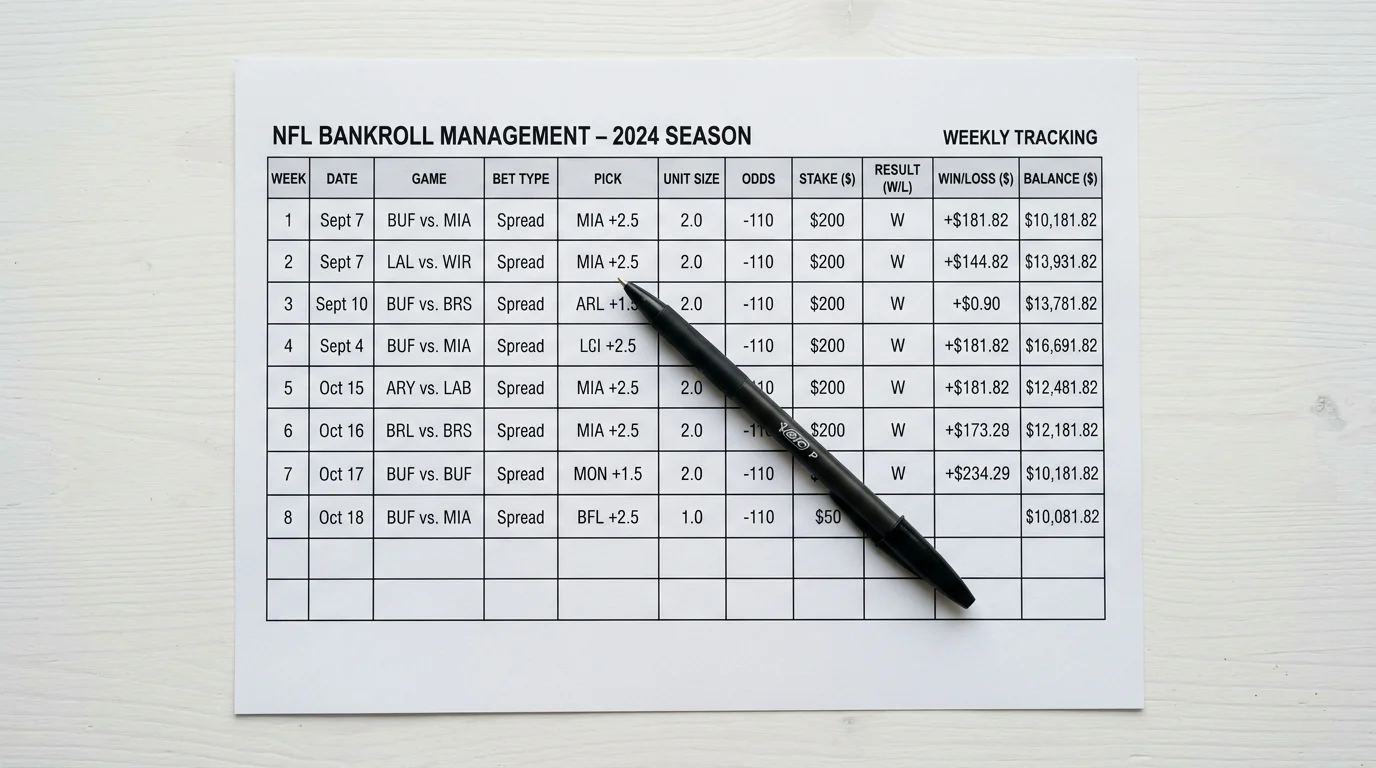
Fourth, record every bet with the odds taken and the closing odds. Review monthly. If your CLV average is negative, your process needs refinement — you are not finding value, you are finding bets. There is a significant difference, and the only way to know which category you fall into is to measure it.
How do I know if an NFL bet has value?
A bet has value when the bookmaker’s implied probability is lower than your own assessed probability of the outcome occurring. Convert the odds to a percentage, compare it against your analysis, and if your number is higher, the bet offers positive expected value over the long term.
Is closing line value relevant for UK punters?
Closing line value is the most reliable measure of betting skill regardless of geography. UK punters can track it by recording the odds they take and comparing them to the final pre-kickoff odds at the same bookmaker. A consistently positive CLV average indicates genuine analytical edge.
Created by the ”Sports Betting nfl” editorial team.