NFL Betting Odds Formats for UK Punters
 Available in US

I still remember my first NFL wager — a straight moneyline bet on the Patriots back in 2017. The American site I was cross-referencing showed -160, my UK bookmaker listed 5/8, and a European exchange had 1.63. All three numbers meant the same thing, and I had no idea. That confusion cost me about twenty minutes of frantic Googling on a Sunday evening when I should have been watching the game.
If you are betting on the NFL from Britain, you will run into this exact problem. The sport was born in the United States, so most analysis, podcasts, and tipster content use American odds. UK bookmakers default to fractional or decimal. And the NFL wagering market — now handling roughly $30 billion in legal bets per season in the US alone — produces odds content at a pace that makes format literacy essential, not optional. Bill Miller of the American Gaming Association put it well: by choosing legal, regulated sportsbooks, fans support a safe and responsible market. That holds true on this side of the Atlantic too, but only if you actually understand what the numbers on screen are telling you.
This guide strips the mystery out of all three formats. By the end, you will convert between them in your head, know which format suits your style, and never again second-guess whether +130 is better than 13/10.
Comparing Fractional, Decimal, and American Odds
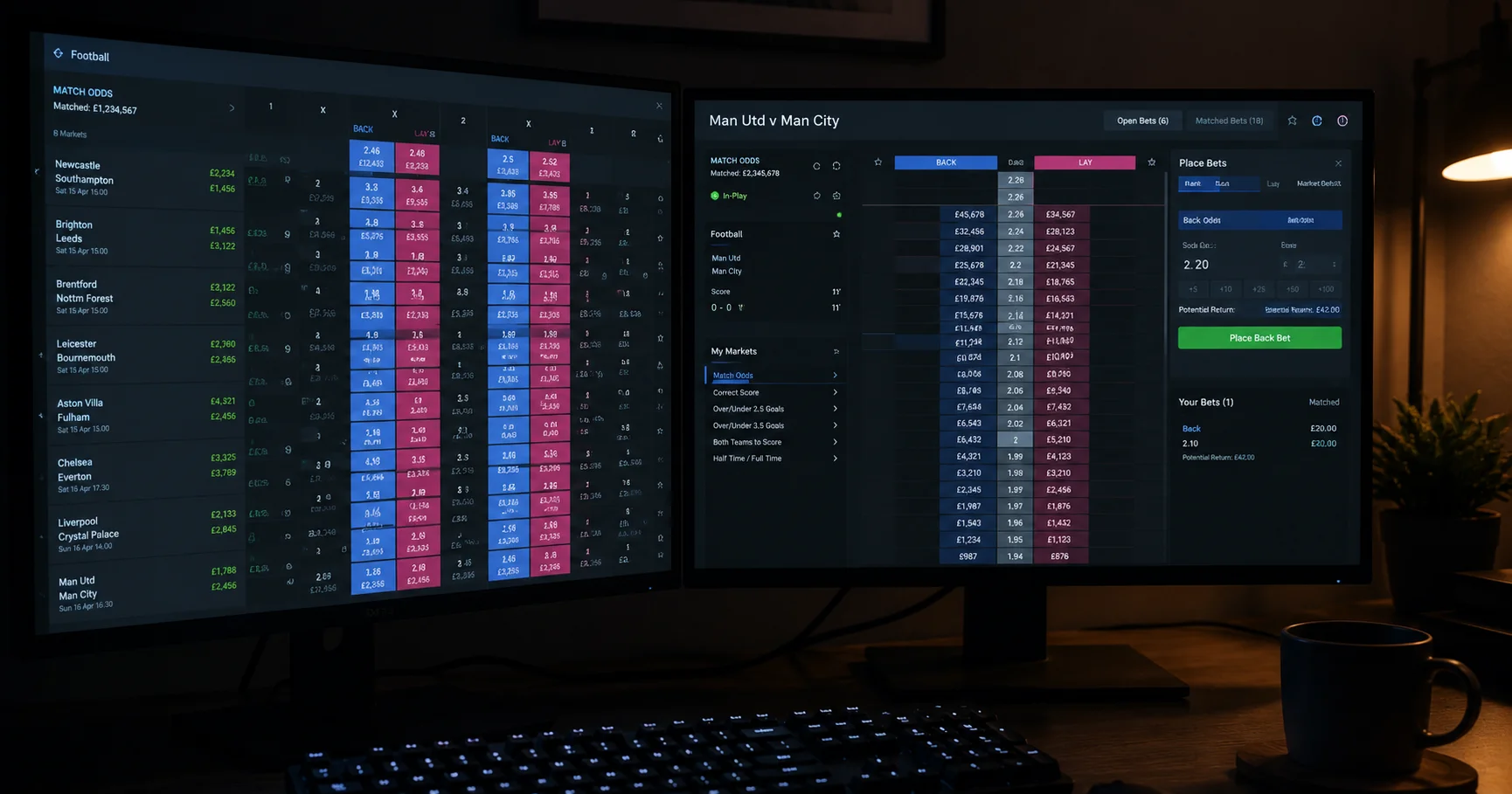
Walk into any high-street betting shop and the screens show fractional odds. Open an app from the same operator and the default might be decimal. Pull up an NFL preview from an American analyst and everything is in moneyline format with plus and minus signs. Three systems, one purpose: telling you how much profit a winning bet returns relative to your stake.
Fractional Odds
Fractional odds are the traditional British format — the 5/1, 11/4, 4/9 you grew up seeing on horse racing and Premier League markets. The first number represents potential profit, the second represents the stake. A 5/1 bet pays five pounds profit for every one pound wagered, plus the original stake back. When you see 11/4, you earn eleven pounds for every four staked. Simple enough when the fractions are clean, but NFL lines often produce awkward numbers like 10/11 or 8/13 that make mental arithmetic a chore.
Fractional odds also carry an intuitive signal: if the first number is larger, you are looking at an underdog. If the second number is larger, that selection is the favourite. A team priced at 6/4 is less likely to win than a team at 4/6, and you can see that at a glance.
Decimal Odds
Decimal odds dominate continental Europe and have been gaining ground in the UK, particularly among younger bettors and exchange users. The number represents the total return per unit staked, including the stake itself. So 2.50 means a one-pound bet returns two pounds fifty in total — one pound fifty profit plus your pound back. Converting to implied probability is straightforward: divide one by the decimal. 2.50 gives you 0.40, or a 40% implied chance.
I find decimals the cleanest format for comparing NFL lines across multiple bookmakers. When one site offers 1.91 on an NFL spread and another offers 1.95, the difference is visible instantly. Try spotting that gap in fractional form — 10/11 versus 20/21 — and your eyes glaze over.
American Odds
American odds revolve around the number 100. A negative figure tells you how much you need to stake to win 100 units of profit. A positive figure tells you how much profit a 100-unit stake returns. So -150 means you stake 150 to win 100. +130 means a 100 stake returns 130 profit. The favourite always carries the minus sign; the underdog always carries the plus.
This format dominates NFL coverage because the league is American. When you read a breakdown on ESPN or listen to a US-based betting podcast, everything is in American odds. About 61% of NFL bettors gravitate toward the point spread as their primary market, and that market is almost universally discussed in American format. Learning to read it — even if you never set your bookmaker to display it — is a practical necessity for anyone consuming NFL betting content seriously.
Each format encodes the same information. The difference is presentation. Your job is to pick the one that lets you make fast, accurate comparisons — and to recognise the other two when they appear.
How to Convert Between American, Fractional, and Decimal Odds
A few seasons ago I built a spreadsheet that did all of this for me. Then I lost the file during a laptop change and realised I had never actually memorised the conversions. Do not make my mistake. These formulas are simple once you practise them a handful of times.
American to Decimal
For positive American odds, divide the odds by 100 and add 1. So +130 becomes 130 / 100 + 1 = 2.30. For negative American odds, divide 100 by the absolute value and add 1. So -150 becomes 100 / 150 + 1 = 1.667.
Decimal to Fractional
Subtract 1 from the decimal, then express the result as a fraction. Decimal 2.30 becomes 1.30, which is 13/10. Decimal 1.667 becomes 0.667, which is roughly 2/3. Some results need rounding to the nearest standard fraction — bookmakers do not display 1.667/1 — but the principle holds.
American to Fractional
Positive American odds convert directly: +130 is 130/100, which simplifies to 13/10. Negative odds flip the relationship: -150 means the fractional odds are 100/150, simplifying to 2/3.
A Worked Example
Suppose you are looking at an NFL game where the Kansas City Chiefs are favoured. An American source lists them at -180. Your UK bookmaker shows 4/7 on the same selection. A European exchange displays 1.56. Let us check they all match. Start with -180: 100 / 180 + 1 = 1.556, which rounds to 1.56 decimal. Then 1.56 – 1 = 0.56, expressed as 56/100, simplifying to roughly 4/7. Everything aligns.
For a deeper look at how these odds apply specifically to NFL point spread markets, where the juice on either side of a line often sits at -110, the conversions above become second nature fast.
The implied probability for -180 is 180 / (180 + 100) = 64.3%. For the underdog at +160, it is 100 / (160 + 100) = 38.5%. Notice the two probabilities add up to 102.8%, not 100%. That gap is the bookmaker’s margin — the overround — and understanding it is the first step toward identifying value.
Which Format UK Bookmakers Use by Default and How to Switch
Most UK-licensed operators default to fractional odds the moment you register with a British address. It makes sense — fractional is what the majority of British punters grew up with. But every major operator I have used in the past nine years offers a toggle somewhere in the settings or directly on the odds display. Typically, you will find a small dropdown or set of tabs labelled “Fractional / Decimal / American” either in your account preferences or at the top of the sportsbook page.
My recommendation: set your default to decimal if you are serious about line shopping across multiple sites. When $30 billion flows through the American NFL betting market each season, the analytical content around those games overwhelmingly uses American format. You need to be bilingual. But for the actual act of comparing prices between your UK bookmakers, decimal is faster. The difference between 1.91 and 1.93 is immediately obvious; the difference between 10/11 and 93/100 is not.
Some operators also allow you to switch formats on a per-market basis rather than globally, which is useful when you want to check a specific NFL line against an American source without changing your entire interface. If your bookmaker does not offer that flexibility, consider keeping a second tab open with a free odds converter — there are dozens of them — so you can spot-check whenever you are reading American analysis.
One last detail worth knowing: exchange platforms often default to decimal because their user base skews international. If you are exploring NFL exchange betting alongside traditional bookmaker wagers, you will encounter decimal odds more than any other format. Getting comfortable with decimals now saves friction later.
Choosing Your Working Format
There is no objectively superior format. Fractional suits punters who think in terms of profit relative to stake — “I get five for every one I put down.” Decimal suits people who want total return in a single number. American suits anyone immersed in US sports media. What matters is picking one as your home base and being able to read the other two without hesitation.
I personally settled on decimal about six years into my NFL betting and never looked back. The mental arithmetic for accumulator pricing, implied probability, and cross-site comparison is just cleaner. But I still read American odds fluently because the best NFL content on the planet comes out of the US, and I am not going to ignore it because I do not like minus signs.
Whatever you choose, commit to it. Flip-flopping between formats mid-session is where mistakes creep in — and in a sport where the margin between a sharp bet and a bad one can be as narrow as two percentage points of implied probability, those mistakes add up across a full eighteen-week season.
Why do some UK sites show American odds for NFL?
Some operators detect that NFL is an American sport and switch the default display to American odds for those markets. You can override this in your account settings or via the odds format toggle on the sportsbook page. Most sites let you choose fractional, decimal, or American as your global default.
Which odds format is easiest for calculating payouts?
Decimal is the simplest for payout calculation. Multiply your stake by the decimal odds to get the total return. For example, a 10 pound stake at 2.30 returns 23 pounds. No additional steps or fraction simplification required.
Written by the editors at Sports Betting nfl.